I came here broken. I'm leaving whole. For the first time, I know who I am.
A peaceful community where women rebuild confidence, stability, and independence.
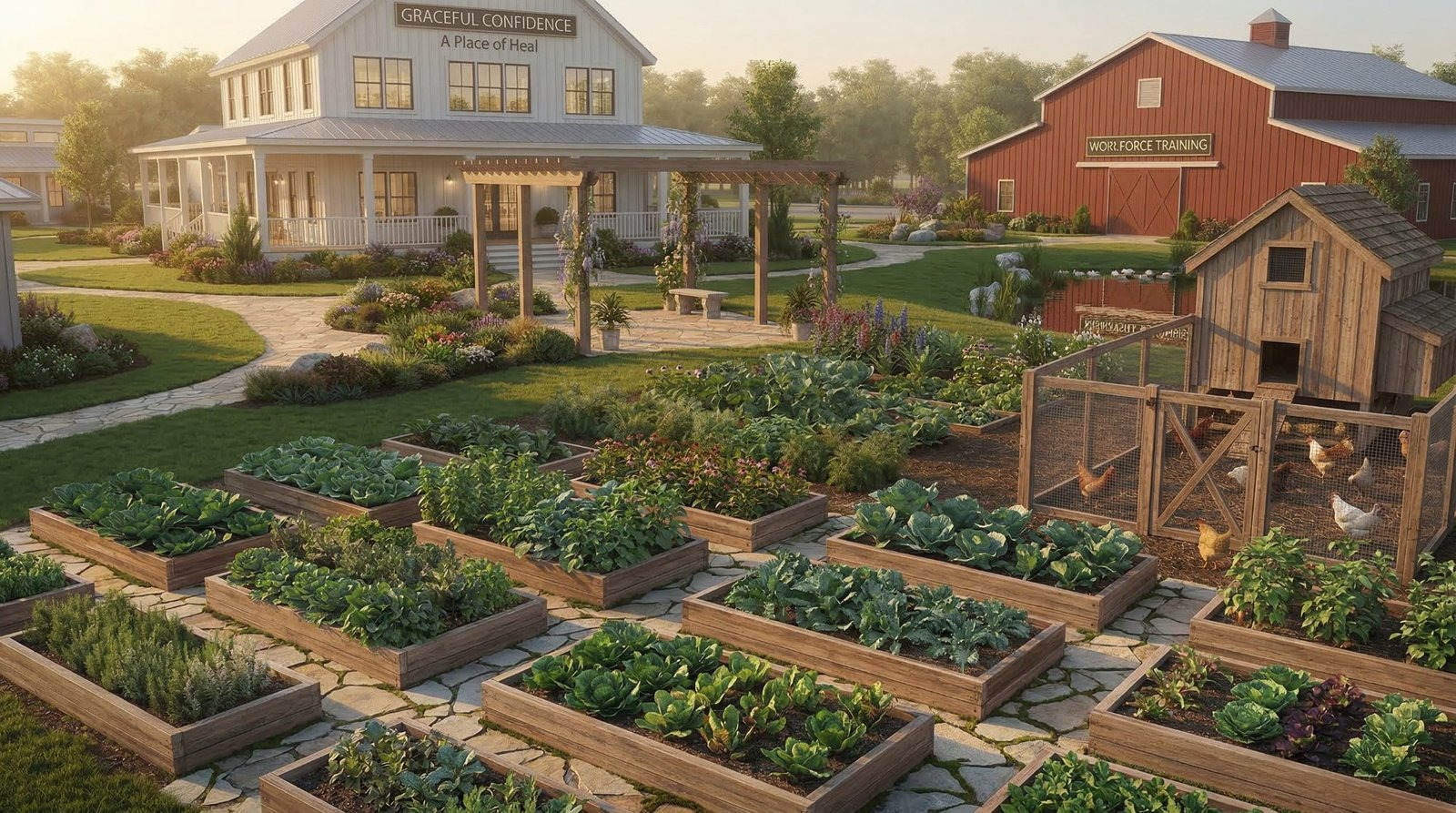
A survivor-led vision for long-term healing in Texarkana, TX/AR.At A Place to Heal, women rebuild stability through peaceful daily routines — gardening, caring for animals, workforce training, and community support in a safe long-term environment.
"Recovery takes time, support, and space — and we are here to walk with you into the future ahead."
— Deborah Barentine, FounderGraceful Confidence provides long-term aftercare, not emergency shelter.
Sometimes choosing truth creates division. Sometimes choosing healing reveals what was hidden. Sometimes choosing peace means stepping away from chaos.
That doesn't mean you're wrong. It means you're growing.
"Be still, and know that I am God."
Psalm 46:10
Because His love is not a burden. It is freedom.
— DeborahMost recovery programs focus on crisis. Graceful Confidence focuses on what comes after.
Survivors often receive emergency safety, short-term counseling, or job support — but rarely a place designed for long-term healing and rebuilding. Graceful Confidence was created to fill that gap.
We provide a survivor-led, community-based aftercare model that supports the full journey from survival to self-sufficient living.
Long-term aftercare, not short-term intervention
Transitional housing designed for dignity
Trauma-informed healing and identity restoration
Confidence-building and life skills development
These are the women Graceful Confidence was built for. Their journeys are their own — shared here with gratitude.
I came here broken. I'm leaving whole. For the first time, I know who I am.

They didn't just give me housing. They gave me back my life. My identity. My future.
I thought I'd never trust myself again. Now I trust myself completely. That's the real healing.
"Healing is hard — and you don't have to do it alone. We will be here, providing trauma-informed care and walking with you toward lasting healing, for generations to come."
— Deborah Barentine, Founder
Most services for survivors focus on immediate safety — and that work is essential. But when the crisis stabilizes, a different and equally urgent need emerges: rebuilding an entire life. According to the National Domestic Violence Hotline, approximately 1 in 4 women experience severe intimate partner violence in their lifetime. The deepest costs are not economic — they are the quiet, persistent losses of identity, confidence, and the capacity to trust oneself and others.
Graceful Confidence exists in that space. We serve women navigating the complex, ongoing process of recovery — often without income, without a clear sense of identity, and without the relational and spiritual foundation that trauma systematically dismantled. We begin where crisis response ends, and we stay for as long as healing takes.
Healing is not linear. It does not happen quickly. Our whole-person model acknowledges that reality and addresses it with sustained, compassionate support across every dimension of a woman's life — neurological, psychological, relational, spiritual, and economic.
Trauma recovery, grief, and nervous system regulation
Identity rebuilding and breaking cycles of confusion
Faith, truth, and renewed sense of self in God
Safe housing, rest, and a dignified environment
Workforce skills, income, and economic self-sufficiency
Boundaries, trust, and recognizing unhealthy patterns
Rebuilding meaning, vision, and a path forward
Keeping women and their animals together through transition
The heart of everything — a growing campus in Texarkana where all programs, spaces, and support connect. Small today, and building toward something much larger.
Private, dignified transitional homes on campus — the physical foundation that long-term recovery requires.
Horticultural therapy supporting emotional regulation, mindfulness, and a renewed sense of growth and agency.
Boundaries, wisdom, and the skills to recognize and protect against harm in future relationships.
Workforce development and employment readiness — building a foundation for true financial independence.
Shared meals, group support, and connection — where belonging is built and healing is strengthened together.
Private, peaceful spaces for one-on-one mentoring, reflection, and guidance at each woman's own pace.
Keeping women and their animals together through the transition — removing a significant barrier to safety.
We believe in being honest about where we are. Graceful Confidence is a seed organization — rooted, growing, and building deliberately toward something much larger.
The vision is a full healing campus in Texarkana where every program, space, and support system works together seamlessly. We are not there yet. But every program we launch, every woman we walk alongside, and every partner who joins us moves us closer.
Graceful Confidence was founded by Deborah Barentine — a survivor of intimate partner violence who, after leaving her situation, encountered the same gap that tens of thousands of women face: a system equipped to help in a crisis, but not equipped to support the long work of rebuilding a life after it.
Deborah built this organization from lived experience. She understands — from the inside — that healing is not an event. It does not happen when you leave. It cannot happen without sustained support that addresses the whole person, not just the most visible wounds.
Graceful Confidence is survivor-led at every level. Our programs are shaped by lived experience. Our approach is grounded in faith — not as a platitude, but as a daily practice of truth, identity, and restoration.
Every outcome is tracked using validated clinical tools at baseline, 6 months, 12 months, and 24 months. Accountability to funders and accountability to the women we serve are the same commitment.
Participants who achieve and maintain stable housing at 12, 18, and 24 months — the foundational outcome that unlocks every other dimension of recovery.
Verified at 3 intervalsParticipants who secure stable employment or enroll in education within their program timeline — building the economic foundation for lasting independence.
Pathways to StabilityMeasurable reduction in trauma symptom severity, depression, and anxiety — assessed using PCL-5, PHQ-9, and GAD-7 at every program interval.
PCL-5 · PHQ-9 · GAD-7Participants who report no return to abusive situations at the 24-month follow-up — the clearest measure of whether a woman has rebuilt safety and discernment.
24-month follow-upComplete GED, college credits, or vocational certification during program
Report meaningful peer relationships and a sustained sense of belonging
Demonstrate proficiency in financial literacy, self-care, and conflict resolution
Report increased self-awareness, authenticity, and confidence at program exit — assessed using Rosenberg SES
Projected outcomes based on evidence-informed model design and comparable program data. Graceful Confidence tracks all metrics using validated tools and reports to funders on a regular basis.
Trauma profoundly disrupts neurological functioning, decision-making, and emotional regulation — effects that persist long after physical safety is secured. Safety alone is not recovery.
Long-term residential programs that integrate therapeutic, economic, and community support consistently outperform short-term or siloed interventions across every outcome measure. Complex trauma requires sustained, integrated care.
Sanctuary Model
Shared safety and trauma-informed community — the foundation of all Graceful Confidence programming.
ARC Framework
Attachment, Regulation, and Competency — addressing the relational impact of complex trauma at every level of care.
Trauma-Informed Design
Physical environment supports nervous system regulation. Biophilic design, natural light, and privacy accelerate healing outcomes.
Every donor, partner, and volunteer is part of how this vision becomes real for women in Texarkana and beyond.
Your gift funds transitional housing, healing programs, workforce training, and the operational foundation that makes sustained aftercare possible.
Make a Gift →We welcome grant funders, foundations, faith communities, and organizations aligned with long-term survivor support. Let's build something together.
Start a Conversation →From workforce mentors to garden stewards to administrative support — there is a meaningful role for those willing to commit to this work.
Get Involved →We are a survivor-led, faith-forward organization committed to the long, real work of helping women rebuild their lives after trauma — with no rush, no shortcuts, and no one left to walk it alone. Our model is evidence-based, our outcomes are measurable, and our vision is expanding.
Crisis response saves lives. But when the immediate danger passes, a woman is often left to navigate one of the most complex challenges a person can face: rebuilding an entire life — identity, income, housing, relationships, faith, and sense of future — largely alone.
Graceful Confidence was founded to fill that gap. We are a long-term aftercare organization. We don't measure success in days or weeks. We measure it in the slow, steady restoration of confidence, stability, and self-sufficient living.
We are a small organization with a clear vision and a growing campus in Texarkana. We are planting seeds today that will grow into something much larger.
Our mission is to provide trauma-informed, long-term aftercare for women impacted by intimate partner violence and trauma — supporting their journey toward emotional healing, physical stability, spiritual restoration, and economic independence.
We believe recovery is not a program you complete. It is a process you walk through — and no woman should have to walk it alone.
Every woman is treated as a whole person — never a case number, statistic, or problem to be managed.
We don't promise quick fixes. We tell the truth about the journey — and we walk it alongside every woman, for as long as it takes.
Our faith-forward approach shapes how we see the women we serve — as whole people made for restoration.
Lived experience is not just a credential here — it is the foundation of every program, decision, and interaction.
Trauma affects every dimension of a person's life. Our model addresses all of them — because lasting recovery requires nothing less.
We commit to walking with women for as long as the rebuilding process takes — not until a funding cycle ends.
Abuse dismantles a person's life across every dimension. Our whole-person model addresses each one — not in isolation, but as an integrated, interconnected approach to lasting recovery.
Trauma recovery, grief, nervous system regulation
Identity rebuilding, decision-making, breaking confusion
Faith, truth, renewed relationship with God
Safe housing, rest, dignified environment
Workforce skills, income, economic self-sufficiency
Boundaries, trust, recognizing unhealthy patterns
Rebuilding meaning, vision, and a clear path forward
Keeping women and their animals together through transition
"If women who have experienced intimate partner violence and complex trauma are provided with long-term, trauma-informed, whole-person residential support in a physically healing environment — including therapeutic care, identity restoration, confidence-building, and workforce development — then they will rebuild the internal and external resources necessary for stable, self-sufficient, and fulfilling independent lives."
Outcome tracking is not solely a grant compliance function — it is how the organization learns, improves, and demonstrates accountability to the women it serves.
100% of participants complete Phase 1 without safety incidents. Long-term goal: 80%+ reduction in housing instability among alumni.
Measurable reduction in trauma symptom severity using validated clinical tools. 75%+ sustain mental health gains 12 months post-exit.
Statistically significant confidence gains at program exit. 80%+ report sustained sense of identity and self-worth at 24-month follow-up.
70%+ complete full workforce development curriculum. 60%+ achieve stable employment or enrollment in education within program timeline.
100% receive individualized, collaborative transition plans. Active alumni network sustained at each campus site beyond program exit.
When a survivor achieves stability, the effects are generational — children in stable homes, reduced emergency system demand, stronger communities for everyone.
Expansion is not the goal in itself — sustainable, high-quality impact is. Growth follows evidence.
Deborah Barentine founded Graceful Confidence from lived experience. As a survivor of intimate partner violence, she walked through the exact gap this organization exists to fill — a system that could respond to crisis, but couldn't support the long journey of rebuilding.
That experience is the foundation of everything Graceful Confidence does. Every program, every space, and every approach is shaped by what Deborah knows — from the inside — about what women actually need when the immediate danger has passed and the real work begins.
Deborah's faith is central to the work. Graceful Confidence is not a clinical organization. It is a community built on the belief that every woman has been created for restoration — and that no one should have to find their way back alone.
Each program addresses a different dimension of recovery. Together they form a complete, integrated model of long-term aftercare — built on five clinical pillars and delivered across a four-phase participant journey, supporting women from the inside out.
The heart of everything — a growing campus community in Texarkana where all programs, spaces, and support systems connect. The Healing Place is a vision for what whole-person recovery looks like when it is given room to grow. Today we are planting seeds. The full campus — with housing, gardens, gathering spaces, training, and quiet rooms for restoration — is what we are building toward.
Safe, stable housing is the foundation that everything else is built on. Confidence Cottages provides private, dignified transitional homes on the Graceful Confidence campus — giving women the physical stability and breathing room that long-term recovery requires. These are not dormitories. They are small, private homes where a woman can rest, stabilize, and begin to rebuild without the pressure of housing insecurity.
Trauma lives in the body. Healing happens through the whole person. Our Therapeutic Gardens program uses structured horticultural therapy to support nervous system regulation, mindfulness, and a renewed sense of growth and agency. Tending living things — watching them grow through seasons — is a practice in patience, hope, and the possibility of new life that no clinical setting can replicate.
Abuse reorders a woman's understanding of what is safe, trustworthy, and normal. The Gatekeeping Project addresses that directly — through structured sessions focused on boundaries, wisdom in relationships, and the patterns that can leave women vulnerable to harm. This is not about blame. It is about equipping women with the clarity and tools to protect themselves and move forward with confidence.
Financial dependence is one of the most common tools abusers use to maintain control — and financial independence is one of the most powerful things a woman can reclaim. Pathways to Stability provides real workforce skills, resume development, job readiness coaching, financial literacy, and connections to employment partners in the Texarkana region. This is not just job training. It is the foundation of a self-sufficient life.
A welcoming community space where women come together for shared meals, group support, life skills training, and genuine connection. The Table is where relationships are built, encouragement is shared, and healing is strengthened through community. Recovery is not meant to happen in isolation — and belonging to something larger than yourself is part of becoming whole again.
Private, peaceful spaces designed for one-on-one support, reflection, and guidance. These spaces provide a safe environment where women can process their experiences, receive mentoring, and begin rebuilding with clarity and confidence — at their own pace, without pressure or an audience. Sometimes healing requires stillness. Quiet Spaces for Restoration makes room for that.
Pets are family — and the fear of losing a companion animal is one of the most common reasons survivors delay or avoid leaving dangerous situations. Pet Pods removes that barrier. We provide safe, caring accommodations for survivors' animals during the transition period, so women can focus on their own safety and recovery without being forced to leave a beloved companion behind.
Behind every program is a clinical framework grounded in evidence-based practice. These five pillars are not isolated services — they are designed to reinforce one another and address every dimension of a survivor's recovery.
All programming is grounded in the six principles of trauma-informed care: safety, trustworthiness, peer support, collaboration, empowerment, and cultural sensitivity. Clinical modalities include individual and group therapy, somatic experiencing, and mindfulness-based practices, drawing from the Sanctuary Model and Attachment-Regulation-Competency (ARC) framework.
Trauma fragments identity. By the time a woman reaches safety, she often does not know who she is apart from what she has endured. Through expressive arts therapy, narrative therapy, and guided self-reflection, participants begin recovering the self that existed before the harm — and discovering who that person has become through survival.
The organizational cornerstone of Graceful Confidence — and the most chronically neglected dimension of survivor recovery. Trauma systematically dismantles self-efficacy. Through structured skill-building, progressive leadership development, and meaningful contribution to the campus community, participants rebuild confidence through practice and lived experience, not simply encouragement. Progress is measured using validated assessment tools at intake, mid-program, and exit.
Trauma is held in the body, expressed through relationships, felt in spiritual disconnection, and lived in daily physical health. Wellness programming addresses every dimension: nutritional education and communal meals, movement practices including yoga and nature walks, mental health counseling, and optional values-based spiritual care. Spiritual programming is inclusive, non-coercive, and opt-in — never a condition of participation.
Economic independence is not separate from long-term recovery — it is one of its essential foundations. Survivors who lack economic self-sufficiency are at significantly elevated risk of returning to dangerous situations simply because they have no alternative. Programming includes resume development, interview coaching, vocational training partnerships, financial literacy, and independent living skills. Campus-based social enterprise opportunities provide integrated vocational experience while contributing to organizational sustainability.
The journey of a Graceful Confidence participant does not begin at program entry. It begins long before — in the years of harm endured, the identity eroded, and the moment when leaving became possible. What she needs now is not urgency. She needs time, structure, and a program that will remain present.
She has left. The immediate danger is behind her. What she needs now — more than anything — is to feel safe.
"Safety, rest, and the beginning of trust."Trauma, loss, confusion, and exhaustion. She may not trust her own perceptions yet. She is not yet ready to do the deep work — and we don't ask her to.
The deepest therapeutic work. This phase takes time — and it cannot be rushed without causing harm.
"Discovering who you are beneath the trauma."Deep trauma processing, identity exploration, and grief. She may not know who she is apart from what she survived. This phase creates the conditions for her to begin finding out.
She knows who she is now. It is time to build the life that reflects it.
"Building the skills and confidence for independence."Building confidence, developing competence, and beginning to see a future. She is contributing to the campus community — and discovering that her judgment is sound and her contributions are valued.
Transition is not an exit. It is a passage into the next chapter — one she is finally ready to write.
"Stepping into your future with dignity and strength."Moving toward independence with hope. She knows who she is, what she is capable of, and what she deserves. She is ready — and she knows the community behind her doesn't disappear when she leaves.
Your donation funds the programs, spaces, and sustained support that make long-term recovery possible for women in the Texarkana region.
Graceful Confidence is a growing organization doing work that matters. Your support makes it possible — one woman, one step, one season at a time.
Crisis response is funded. Long-term aftercare rarely is. That gap is where women fall through — not because they stopped needing help, but because the help stopped showing up.
Graceful Confidence fills that gap. Your gift funds the programs, spaces, and sustained support that make it possible for women in Texarkana to rebuild — fully, sustainably, and on their own terms. The Graceful Confidence pilot serves 4–8 women at a time, providing up to 18–24 months of residential aftercare — the sustained duration that research identifies as essential to lasting recovery.
We are honest: we are a small, growing organization with a large vision. Every dollar moves us closer to the full campus we are building — and every dollar directly touches the lives of women we serve right now.
We are committed to responsible stewardship of every gift. We operate with financial transparency and an unwavering commitment to the mission. As a registered 501(c)(3) nonprofit, all donations are tax-deductible to the fullest extent permitted by law.
Graceful Confidence is positioned to pursue public grants through the Office on Violence Against Women (OVW), HUD Continuum of Care programs, FVPSA, and SAMHSA — as well as private foundation funding aligned with trauma recovery, women's empowerment, and long-term housing stability.
A one-time or recurring donation funds safe housing, healing programs, workforce training, and the daily operational needs of our growing organization.
Recurring monthly gifts provide the sustained funding that long-term aftercare requires — and are especially meaningful to our work.
We welcome corporate sponsorships, employee giving programs, cause marketing partnerships, and in-kind donation agreements from organizations seeking meaningful community impact.
Let's explore what a partnership could look like.
We welcome grant funding from foundations committed to ending intimate partner violence, expanding transitional housing, supporting workforce development, and advancing trauma-informed community care.
Our team is available to discuss program alignment and partnership opportunities.
Your time, skills, and resources are powerful gifts. We welcome volunteers with backgrounds in counseling, education, finance, technology, construction, landscaping, and more.
If you have a skill, we have a place for it — and a woman whose life will be changed by your showing up.
Provides seeds, tools, and supplies for one week of Therapeutic Gardens — supporting emotional healing through growth.
Funds one month of Gatekeeping Project materials — equipping women with the boundary skills and relational wisdom they'll carry for life.
Covers one month of Confidence Cottage utilities and maintenance — keeping a woman's transitional home safe, warm, and welcoming.
Fully funds a woman's participation in Pathways to Stability — six months of workforce development, financial literacy, and employment coaching.
We are committed to transparency, accountability, and responsible stewardship of every gift.
The largest portion of every dollar goes directly to delivering our eight healing programs — staffing, materials, certifications, and therapeutic resources for the women we serve.
Funds support the maintenance, furnishing, and operation of Confidence Cottages and campus facilities — ensuring survivors have safe, dignified spaces to call home.
A portion of each gift supports the infrastructure that allows Graceful Confidence to grow, strengthen our model, and serve more women in more seasons.
Graceful Confidence uses milestone-based outcomes rather than fixed timelines — because trauma-informed care recognizes that healing is not linear and cannot be rushed without causing harm.
We track meaningful, verifiable progress across every dimension of our whole-person model. Each woman's journey is documented through regular assessments, participant feedback, and program-specific indicators that give funders a clear, honest picture of impact.
We believe accountability to our funders and accountability to the women we serve are the same commitment — and we honor both.
Percentage of participants who secure stable permanent housing upon leaving Confidence Cottages
Percentage of Pathways to Stability participants who secure stable employment within their program cycle
Participant-reported wellbeing, confidence, and emotional regulation scores measured at intake, midpoint, and completion
Program engagement and retention rate — how many women remain actively involved in aftercare over time
Number of women served per quarter across all active programs, tracked and reported to funders regularly
Percentage of participants who report no return to abusive relationships or situations after completing aftercare
Crisis response funding saves lives in the moment. Aftercare funding changes the trajectory of those lives permanently. Graceful Confidence sits at that second, underfunded intersection — and we are building a model that produces verifiable, long-term outcomes for women in the Texarkana region.
We welcome conversations with foundations, government agencies, and grant makers aligned with our mission areas. Our team is available to discuss program design, evaluation frameworks, reporting structures, and site visits.
Long-term survivor support, trauma-informed care models, and whole-person healing frameworks
Safe, dignified transitional housing that provides the physical foundation for lasting recovery and independence
Skills training, employment readiness, and financial literacy programs that lead to sustained economic self-sufficiency
Horticultural therapy, peer support, mentoring, and community connection as pillars of long-term mental health recovery
Funders committed to supporting grassroots, survivor-led nonprofits with authentic community roots and lived-experience leadership
Debbie Barentine's story is one of survival, of a faith that refused to let go, and of a slow, imperfect restoration that is still unfolding. Graceful Confidence was born from what she lived.
Long before adulthood, Debbie learned to carry what wasn't hers to carry. She grew up in a home marked by instability and emotional harm, where love often felt conditional and her own feelings were the last ones allowed in the room.
Those early years quietly shaped the way she understood herself — and the way she understood relationships. They left her vulnerable in ways she couldn't yet name, open to harm she didn't yet recognize as harm.
Debbie's story doesn't begin with the night everything changed. It begins much earlier, in the small, invisible ways a person learns to make themselves small.
"She learned early to carry responsibility for others' emotions while silencing her own."
The early years that shaped everything afterAs an adult, Debbie found herself in a relationship that grew increasingly unsafe. One night, the tension broke into something she could no longer minimize. She was chased through her own living room, slammed into a wall, knocked to the ground.
As she lay there, she remembers the thought that passed through her mind: he might kill me. He taunted her. He filmed her. And somewhere in the middle of that terror, her daughter Morgan walked into the room.
That was the moment. Debbie ran to the bathroom, locked the door, and called 911.
When police arrived, his family was already there — on the couch, composed, presenting a different story. He told officers she had fallen. An officer pulled Debbie outside and showed her the scrapes on her skin. They could take him to jail. She had every right to press charges.
But when she stepped back inside, Morgan was screaming. Don't take him. Debbie asked only that he leave. She sat down on the bench in her living room in the quiet that followed — and something surfaced that she hadn't expected.
I feel like a statistic.
She said it out loud. It sounded strange to her own ears. But something had shifted. She was beginning to wake up.
A few months later, Debbie found herself on the floor of a spare bedroom. On her knees. Praying the kind of prayer you mean with everything you have left.
"God, if you get me out of here,
I will go where you want me to go,
say what you want me to say,
and be who you want me to be."
That prayer didn't fix everything. Healing rarely arrives that cleanly. But it marked a turning point — a new direction she began, slowly and imperfectly, to walk toward.
Debbie's name is the same as the biblical Deborah — a leader who didn't seek the role, but answered the call anyway. That resonance isn't lost on her. She never imagined herself as a founder. She imagined herself surviving.
The longer Debbie walked her own road of recovery — navigating grief, rebuilding boundaries, learning who she was apart from what she had endured — the more she understood something important.
Survivors need more than an exit. They need time. Safety. Dignity. A place to remember who they are. They need support that doesn't disappear when the crisis does.
Her healing is not finished. She would tell you that herself. But she has learned that a story doesn't have to be complete to be useful — and that the most powerful thing she can do with what she's been through is make sure someone else doesn't have to walk it alone.
Graceful Confidence exists to provide what Debbie once needed — a safe transitional space, a community that holds survivors with dignity, and real opportunities to rebuild the confidence that trauma quietly takes away.
This organization was built by someone who lived it. And it is shaped, at every level, by a belief that has carried Debbie through everything she has walked through:
"We don't tell women that healing is easy. We tell them the truth: it is possible, it takes time, and they don't have to do it alone."
— Deborah Barentine, FounderWhether you are a woman seeking support, a donor, a foundation, or someone who simply wants to help — our door is open.
Reach out using the form or the contact details below. We respond to all inquiries within two business days. If you are a woman in need of immediate support, please use the crisis resources listed here.
If you or someone you know is in immediate danger, please call 911. For confidential support, the National Domestic Violence Hotline is available 24 hours a day, 7 days a week.
1-800-799-7233You can also text START to 88788.
We typically respond within two business days. If you need immediate support, please call the National Domestic Violence Hotline at 1-800-799-7233.
Positioning · Model · Mission
Most recovery services are built around a single need — a roof, a therapist, a job. Graceful Confidence is built around a whole person. We are the only aftercare model in the region that integrates housing, healing, identity restoration, workforce development, and community — under one roof, across one journey, for as long as recovery takes.
Today's system for survivors of intimate partner violence is built around isolated services — emergency response here, therapy there, job training somewhere else. Each plays a role. None is designed to hold a woman through the full arc of recovery.
A woman who needs housing doesn't automatically receive counseling. A woman receiving therapy doesn't automatically have a stable place to sleep. A woman in a workforce program is often still living in instability that undermines her progress. The services are siloed. The woman is not.
30–90 days of crisis housing. Necessary — but not designed for the long work of recovery.
Therapy without housing or economic support. Healing is harder without a stable foundation.
Job skills without addressing identity, trauma, or the healing that sustainable employment requires.
Community and spiritual care — but rarely the clinical and economic infrastructure for full recovery.
The result: Women move from program to program, re-entering crisis, falling through referral gaps, and losing momentum at every transition. Long-term stability requires long-term, integrated support — and that system doesn't exist at scale. Graceful Confidence is building it.
Graceful Confidence is not a shelter that also does counseling. It is not a workforce program that also offers housing. It is a purpose-built integrated model where every element is designed to reinforce every other element.
Housing creates the stability that makes therapy productive. Therapy creates the identity clarity that makes workforce development sustainable. Community creates the belonging that makes all of it last. These are not add-ons — they are a system.
The result is a healing environment where a woman doesn't lose progress when she moves between programs. She doesn't lose her home because her therapy isn't covered. She doesn't lose her job training because her housing fell through. She stays in one community, with one support network, for as long as her recovery takes.
All programs. One campus. One journey.
Each model serves an important purpose. Graceful Confidence is built to do what no single-service model can.
| Dimension | Emergency Shelters | Counseling Centers | Workforce Programs | Graceful Confidence ✦ |
|---|---|---|---|---|
| Duration of Support | 30–90 days | Ongoing (no housing) | 3–6 months | 12–18+ months |
| Housing Provided | Temporary, communal | None | None | Dignified transitional homes |
| Therapy & Counseling | Crisis-focused | Primary service | None | Integrated throughout |
| Workforce Development | None | None | Primary service | Integrated throughout |
| Identity Restoration | Not addressed | Therapy-focused only | Not addressed | Central program pillar |
| Community Support | Transient residents | Individual clients | Temporary cohort | Stable, ongoing campus |
| Aftercare & Alumni | Referral only | Continued therapy | Job placement | Robust alumni network |
| Core Philosophy | Emergency response | Clinical treatment | Economic mobility | Whole-person transformation |
| Integrated Model | No | No | No | ✓ Yes |
This comparison reflects general model characteristics, not a critique of individual organizations. All service types contribute meaningfully to the recovery landscape.
Research consistently demonstrates that integrated, long-term support produces outcomes no single-service model can match. Here is what that looks like in practice.
When housing is secure, therapy works. When therapy works, employment holds. The physical foundation of Confidence Cottages makes every other outcome more achievable and more durable.
Trauma fragments identity. Long-term, sustained therapeutic support — not crisis counseling — is what allows a woman to rebuild her sense of self and trust her own judgment again.
Workforce development without housing or emotional stability has a low long-term success rate. Integration means participants enter employment ready — not just trained.
Women who leave without learning to recognize unsafe patterns are at elevated risk of re-entering dangerous situations. The Gatekeeping Project addresses this — changing the long-term trajectory.
Questions of identity, purpose, and worth are ultimately spiritual. A model that does not address this dimension leaves a woman only partially restored. We hold space for all of it.
A woman who achieves genuine stability — financially, emotionally, spiritually — creates a different future for her children. The impact of this work extends far beyond the individual.
Explore our eight programs, our four-phase participant journey, or connect with our team for a funder briefing.
For Funders · Foundations · Grant Makers
We've Built the Model That Works
Graceful Confidence is not another crisis response program. We are a purpose-built, evidence-informed aftercare model that addresses every dimension of a survivor's recovery — and produces verifiable, long-term outcomes. Your investment funds something that does not yet exist at scale: integrated, sustained healing for women who have survived intimate partner violence.
Approximately 1 in 4 women experience severe intimate partner violence in their lifetime. When they leave, they encounter a fragmented system — emergency shelter here, therapy there, workforce program somewhere else. Each is necessary. None is designed to hold a woman through the full arc of recovery.
The result is predictable: women cycle through crisis, lose housing, lose employment gains, lose therapeutic progress. Not because they aren't resilient — because the system was never built for the long work of rebuilding a life. Long-term residential aftercare is severely underfunded and underbuilt. Graceful Confidence is building it.
Women experience severe IPV in their lifetime — the primary population Graceful Confidence serves. — National Domestic Violence Hotline
Days — average emergency shelter stay. Long-term recovery takes 18–24 months. The gap between those two numbers is where women fall through.
Annual economic cost of IPV in the US — including medical costs, lost productivity, and criminal justice expenses. Prevention and aftercare reduce this burden measurably.
Trauma disrupts every dimension of a woman's life. So does recovery. Graceful Confidence is the only aftercare model designed to address all eight — under one roof, across one sustained journey.
Nervous system regulation, grief processing, trauma recovery through therapeutic gardens and clinical support
Identity rebuilding, decision-making restoration, and breaking cycles of confusion through structured psychoeducation
Faith, truth, and renewed sense of self — inclusive, non-coercive spiritual care woven throughout the program
Dignified transitional housing that creates the safety foundation every other dimension of healing requires
Workforce skills, income pathways, financial literacy, and the economic self-sufficiency that makes safety permanent
Boundaries, trust, and the skills to recognize and protect against harm in future relationships
Rebuilding meaning, vision, and a path forward — the dimension that sustains all other gains long-term
Removing the barrier that keeps thousands of women from leaving — our campus welcomes survivors and their animals
Graceful Confidence uses milestone-based outcome tracking rather than fixed timelines — because trauma-informed care recognizes that healing is not linear. Every participant's progress is documented at intake, 6-month, 12-month, and 24-month intervals using validated clinical tools.
We believe accountability to funders and accountability to the women we serve are the same commitment. Our outcome data is transparent, verifiable, and reported to all major funders on a regular basis.
Trauma symptom severity, depression, anxiety, self-esteem, and behavioral health assessed at every interval. Progress is verifiable, not anecdotal.
Participants who achieve stable housing at 12, 18, and 24 months post-program entry
Participants who gain stable employment or enroll in education within program timeline
Measurable reduction in trauma symptom severity using PCL-5 and PHQ-9 at 12-month interval
Participants who report no return to abusive situations at 24-month follow-up
Every outcome is tracked at four defined intervals — ensuring accountability to funders and continuity of care for participants.
Full intake assessment across all 8 dimensions. Individualized care plan established.
Mid-program clinical reassessment. Care plan adjusted. Housing and therapeutic progress documented.
Full outcomes review. Employment and education status. Confidence and identity scaling scores.
Alumni follow-up. Long-term stability, safety, and wellbeing. Generational impact indicators.
Investing in long-term aftercare is dramatically more cost-effective than the systems activated by untreated trauma. The comparison is not close.
| Service Type | Avg. Duration | Est. Cost / Person | Long-Term Outcome | Graceful Confidence Advantage |
|---|---|---|---|---|
| Emergency Shelter | 30–90 days | $3,000–$8,000 | Stabilization only; high re-entry rate | Sustained care vs. crisis cycling |
| Outpatient Counseling | 6–12 months | $5,000–$15,000 | Therapeutic gains; no housing stability | Integration amplifies clinical outcomes |
| Crisis Hospitalization | 3–7 days | $10,000–$30,000 / episode | Acute stabilization; high recurrence | Prevention reduces hospitalization need |
| Incarceration (related) | Varies | $35,000–$60,000 / year | No therapeutic value; generational harm | Recovery pathway eliminates root drivers |
| Graceful Confidence | 12–18 months | $24,000–$36,000 total | Housing stability, employment, no return to abuse | Integrated model; verified long-term outcomes |
Every woman who achieves stability reduces ER visits, crisis hospitalizations, law enforcement calls, and emergency shelter re-entries — generating measurable savings across public systems.
Participants who gain stable employment contribute income tax revenue, reduce public benefit dependency, and enter the regional workforce — a direct economic return to the Texarkana community.
Children raised in stable, non-abusive homes by mothers who have completed recovery have significantly improved outcomes across education, mental health, and economic mobility. The ROI compounds.
We begin in Texarkana with intention — building the evidence base, the operational systems, and the community trust that will allow this model to travel. Each phase is built on the success of the last.
Prove the model. Build the infrastructure. Establish the evidence base that all future growth depends on. Everything we do in Phase 1 is designed to be documented, measured, and replicated.
Seed investment in Phase 1 has the highest leverage of any stage. You are not funding a program — you are funding the model itself. Every dollar here builds the evidence base, the systems, and the trust that make Phases 2 and 3 possible.
Scale to full capacity in Texarkana. Launch all eight programs at depth. Begin documenting the model for replication. By end of Phase 2, Graceful Confidence is a proven, fully operational, evidence-generating campus.
Phase 2 investment expands capacity and deepens the evidence base. You are funding the growth from proof-of-concept to full model — and helping build the replication toolkit that will allow other communities to benefit from what we've built here.
Launch 2–3 additional Trauma Healing Campuses in strategic locations. The model travels — with fidelity, quality oversight, and community trust built into every new site from day one.
Phase 3 investment is systems-change funding. Your gift doesn't serve one campus — it funds the infrastructure that allows integrated long-term aftercare to reach women in communities across the country. This is where the model becomes a movement.
A national network of Trauma Healing Campuses — each one a proven, community-embedded model of integrated long-term aftercare. Graceful Confidence becomes not just an organization, but a movement that changes how this country supports survivors.
Graceful Confidence is building a diversified funding base intentionally — so that no single revenue stream creates organizational vulnerability. Our model combines philanthropic investment, government grants, corporate partnerships, and earned revenue through social enterprise.
This approach mirrors best practices in sustainable nonprofit finance and gives major funders confidence that their investment is part of a durable, growing organization — not a single-grant dependency.
Every investment level funds something specific and tangible. Your gift is not a line item — it is a woman's housing, her healing, or her future.
Provides one month of safe transitional housing — the foundation that makes every other dimension of healing possible.
Supports one survivor's full 12-month program — housing, therapy, workforce development, community, and all eight dimensions of whole-person care.
Funds a complete program pillar for one full year — therapeutic gardens, workforce development, The Gatekeeping Project, or community programming.
Supports the construction or renovation of one Confidence Cottage — a permanent, dignified transitional home that will serve women for years to come.
Partners with Graceful Confidence on a major initiative — campus expansion, endowment funding, or replication strategy. A gift that shapes the organization's trajectory for a decade.
Deborah Barentine founded Graceful Confidence from lived experience. As a survivor of intimate partner violence, she walked through the exact gap this organization exists to fill — a system that could respond to crisis, but couldn't support the long journey of rebuilding a life after it.
After leaving her situation, Deborah encountered what tens of thousands of women experience every year: emergency help in the immediate moment, and very little structured support for what came after. No integrated model. No community built for the long work of recovery. No place that saw her as a whole person and stayed with her for as long as healing took.
She built Graceful Confidence because she needed it. And because she knew she wasn't the only one.
Deborah's faith is central to the work. Graceful Confidence is not a clinical organization. It is a community built on the belief that every woman has been created for restoration — and that no one should have to find their way back alone. Her lived experience shapes every program, every policy, and every decision the organization makes.
We welcome conversations with foundations, government agencies, corporate partners, and individual major donors. Our team is available for briefings, site visits, and proposal discussions.
If you've left a dangerous situation — or you're thinking about leaving — Graceful Confidence is a place designed specifically for what comes next. Not a shelter. Not a program with a checklist. A community where real healing happens, at your own pace.
When you come to Graceful Confidence, the first thing we want you to do is rest. You don't need to have everything figured out. You don't need to be ready to talk about everything. You don't need to convince anyone that what happened to you was serious enough.
We provide safe, private transitional housing on our campus. You have your own space. Your pet is welcome. And from there, at your pace, you'll have access to everything you need to rebuild — healing support, community, job training, and more.
Our program lasts 12–18 months, because real recovery takes real time. We stay with you through all of it.
"I came here broken. I'm leaving whole. For the first time, I know who I am."
Sarah · Graceful Confidence Alumna"They didn't just give me housing. They gave me back my life. My identity. My future."
Maria · Graceful Confidence AlumnaWhat you've been through touched every part of your life. Our programs are designed to meet you in all of it.
A private, dignified home on campus — yours for the duration of your program.
Therapy, therapeutic gardens, and quiet spaces for reflection — healing at your own pace.
Workforce development, financial literacy, and the skills to build a life that's truly your own.
Women who understand. Shared meals, peer support, and the knowledge you're not alone.
You don't need to have everything ready. You just need to reach out. Our intake process is designed to be simple, private, and completely at your comfort level.
Graceful Confidence is an aftercare program. If you are in immediate danger, please use these resources first.
Available 24/7 — confidential, free, safe.
1-800-799-7233Text START to 88788
Emergency Services
If you are in immediate physical danger, call 911.
You don't have to have everything figured out. You just have to take the next step. We'll be here for all the ones after that.
Graceful Confidence is building what does not yet exist at scale — a proven, integrated model of long-term aftercare for survivors of intimate partner violence. Your investment creates the evidence base, the infrastructure, and ultimately the national movement.
Crisis response is funded. Long-term aftercare is not. That gap — between emergency shelter and true independence — is where most women fall through. Not because they aren't resilient, but because the structured support they need simply doesn't exist.
Graceful Confidence is building it. Our integrated model addresses all eight dimensions of recovery — housing, healing, identity, workforce, relationships, spirituality, community, and purpose — under one roof, across one sustained journey.
Phase 1 funding has the highest leverage of any stage. You are not investing in a program — you are investing in the model itself, and in the evidence base that will allow it to scale nationally.
Participants who achieve stable housing at 12, 18, and 24 months
Participants who report no return to abusive situations at 24-month follow-up
Months of sustained residential aftercare — because healing takes time
$1,000 – $4,999
One month of safe transitional housing — the foundation that makes everything else possible.
$25,000 – $99,999
Fund a complete program pillar for one full year — with named recognition and funder briefings.
$100,000+
Support one Confidence Cottage — a permanent home that will serve women for years to come.
We welcome briefings, site visits, and proposal discussions. Our team is ready to share outcome data, program design, and the full investment case.
The most effective support for survivors happens when organizations work together. Graceful Confidence is actively building a network of community partners — service providers, healthcare organizations, employers, faith communities, and more — committed to walking alongside women as they rebuild.
No single organization has everything a survivor needs. The most effective recoveries happen when services are coordinated, referrals are warm, and organizations trust each other to serve the same woman well.
Graceful Confidence is designed to be a strong, reliable partner. We are transparent about what we do, clear about what we don't do, and committed to building relationships with the organizations that serve women before, alongside, and after us.
We are looking for partners who share our commitment to long-term, whole-person recovery — not just crisis stabilization.
We accept referrals from trusted partner organizations — and we make warm referrals back when a woman needs services we don't provide.
We collaborate with healthcare providers, counselors, legal advocates, and social service agencies to ensure no woman falls through the cracks.
We prepare women for employment. Local employers who partner with us gain access to motivated, trained, supported candidates.
Formalize a referral pathway between our organizations — ensuring women you serve can access Graceful Confidence's aftercare programs, and vice versa.
Bring your expertise — healthcare, legal, counseling, financial — directly to our campus. We welcome collaborative service delivery that reduces barriers for women we serve.
Donate goods, services, or expertise that directly support our campus operations — furnishings, food, professional services, construction, landscaping, and more.
Create employment pathways for women completing our Pathways to Stability program. We'll support onboarding and provide continued coaching during the transition.
Churches and faith organizations can offer volunteers, in-kind support, spiritual care, and community connection — extending the healing village beyond our campus.
Colleges, universities, and vocational training programs can extend educational opportunities to our participants — expanding pathways to stable, meaningful employment.
We'd love to explore how our organizations can work together. Reach out to start a conversation — no commitment required.
Graceful Confidence is building something that doesn't yet exist at scale — an integrated, long-term model of aftercare for survivors of intimate partner violence. If you want to do the most meaningful work of your career, this is the team to join.
At Graceful Confidence, we are not just offering a job. We are inviting you into a mission. Every person on our team — from program staff to operations to leadership — is part of why women are able to rebuild their lives.
We are a small, growing organization. That means the work is real, the impact is visible, and your contribution matters in ways that are hard to find in larger institutions. We operate from faith, integrity, and a deep commitment to the women we serve.
We are building our team thoughtfully — looking for people who bring professional excellence and personal mission-alignment in equal measure.
Every day, you know exactly what your work is for. The mission is clear, the population is specific, and the need is real.
Join before the model is fully built. Shape how it develops. Be part of building something from the ground up.
We operate from deeply held values — dignity, restoration, wholeness. Our culture reflects those values in how we work together.
Lead program development and delivery across all eight dimensions of our whole-person model. Requires experience in trauma-informed care, nonprofit management, and a deep personal commitment to the mission.
Work directly with participants to develop individualized care plans, coordinate services, and provide consistent support across the 12–18 month program journey.
Develop and deliver employment readiness programming, build employer partnerships in the Texarkana region, and support participants as they move toward economic independence.
Design and facilitate horticultural therapy sessions for program participants. Background in horticultural therapy, occupational therapy, or related field preferred.
Build and manage Graceful Confidence's volunteer and in-kind donation programs — connecting community members to meaningful ways of contributing to the mission.
Don't see a position that fits? We'd still love to hear from you.
Reach out to learn more about any open position or to introduce yourself. We read every inquiry and respond to those that reflect genuine mission-alignment.
Graceful Confidence is a faith-forward, survivor-led nonprofit building the first integrated long-term aftercare model for survivors of intimate partner violence in the Texarkana region — and designing it to scale nationally.
Graceful Confidence is a survivor-led, faith-forward nonprofit organization headquartered in Texarkana, Texas/Arkansas. Founded by Deborah Barentine — herself a survivor of intimate partner violence — the organization exists to address the critical gap between emergency shelter and long-term independence.
The Graceful Confidence model provides 12–18 months of integrated residential aftercare, addressing eight dimensions of whole-person recovery: housing, emotional healing, mental clarity, spiritual restoration, financial independence, relational health, community, and purpose.
The organization is currently in its foundation phase, launching programs and building its first campus in Texarkana. Phase 2 and Phase 3 expansion plans will extend the model to additional cities, ultimately building a national network of Trauma Healing Campuses.
Women experience severe intimate partner violence in their lifetime — National DV Hotline
Days — average emergency shelter stay. Long-term recovery takes 12–18 months.
Projected housing stability rate at 12, 18, 24 months post-program
Projected no return to abusive situations at 24-month follow-up
Deborah Barentine founded Graceful Confidence from lived experience. As a survivor of intimate partner violence, she encountered the same gap that tens of thousands of women face after leaving: a system equipped for crisis, but not built for the long work of rebuilding a life.
Graceful Confidence is her answer to that gap — and to every woman who has been handed a brochure when what she needed was a community, a home, and time.
"We don't tell women that healing is easy. We tell them the truth: it is possible, it takes time, and they don't have to do it alone."
Deborah Barentine · Founder & Executive DirectorProfessional biography and photo of Deborah Barentine for media use.
One-page fact sheet, mission statement, and key statistics for quick reference.
For interviews, press releases, or editorial inquiries, please use the contact form.
We welcome media inquiries, interviews with our founder, and access to our programs. Reach out to start a conversation.